Of the two monitors Samsung announced last week, the Series 7 was decidedly the middle-of-the road number. But that's not saying much, seeing as how its big brother, the Series 9, is Sammy's first consumer display with a plane line switching panel, and has a 2560 x 1440 pixel count. The Series 7, available in 24- and 27-inch sizes (both 1080p), uses the same matte, 400-nit, SuperBright Plus panel you'll find on the newly announced Series 9 laptop, and as ever it looks bright and clear, even in the face of some oblique viewing angles. For the money ($600 and up), it also has built-in WiDi and MHL, along with an integrated TV tuner. So far as we can tell, after having seen it in person, the biggest thing you'll lose once you step down from the Series 9 (aside from the PLS bit) is design flair. Whereas the Series 9 has a slim aluminum build with glowing touch controls, the Series 7's glossy surfaces pick up fingerprints quite quickly. (Then again, this more or less rocks the same design as last year's Series 9 flagship, so how bad could it be?) Have a peek at our shots below, and stay tuned for a separate look at the Series 9 -- for whatever reason, the one on display at tonight's press event was powered off for the night, so we'll be back sometime soon when we can show you that high-quality PLS display in the buff.
Pantech has been going after the budget-conscious subscribers on AT&T for quite some time now, but it now it finally has the opportunity to do the same thing on Ma Bell's network that it did with Verizon: offer a cost effective handset with LTE included. And we have to say: we were overall quite impressed both with the phone's feel and laundry list of specs. For $50 with a two-year commitment, the newly announced Burst -- available in both black and red -- offer a 1.2GHz dual-core Scorpion CPU, Android 2.3 (which Pantech confirmed to us that it will be upgradeable to ICS at some point in the future), 5MP rear camera with LED flash and 720p HD video capture and 2MP front-facing cam.
Our first impression was rather positive. The 4-inch display will be a convenient option for most, and the Super AMOLED makes it bright and colorful. It felt comfortable in the hand and we enjoyed the smooth design and tapered sides. As always, we were disappointed in the lack of a dedicated camera button, though we can't say it surprises us anymore -- it seems as though Pantech typically shies away from that option. We're not huge fans of the proprietary OS, as mentioned in our review of the Pantech Pocket, but during our brief time with the device, it seems to be incredibly speedy and void of bugs. Check out the gallery below for plenty more angles.
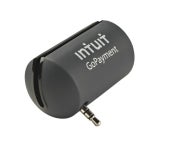
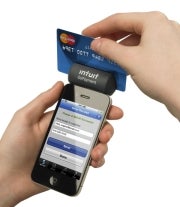
It's shaped like a chubby cork, covered in slate-colored rubber, and connects to mobile devices through--of all things--a headphone jack. But for small businesses, the best thing about Intuit's new credit card swipe attachment may be that it won't cost them a dime, at least not for the hardware alone.
Intuit says it will send the card swiper for free to new customers of its GoPayment mobile payment service, which empowers small businesses to accept credit card payments on mobile devices running a GoPayment app. No contract commitment is required.
Intuit makes money on the service by collecting a card-swipe fee of 2.7 percent of the purchase price (the fee rises to 3.7 percent if you don't actually use the swiper but manually key in the credit card info). High-volume users can opt to pay a monthly fee of $12.95 to get lower swipe rates of 1.7 percent (2.7 percent for keyed-in transactions).
Intuit also said it plans a global rollout for GoPayment, starting with service in Canada "in early 2012," according to a news release. Canadian customers will also get the new card swiper, which replaces a previous model that worked on a couple of dozen Android, Blackberry and iOS devices. The news release says the new swiper is for the iPhone, iPad and iPod Touch.
Intel faces significant competition in the mobile payments arena, most notably from Square, which offers similar service and basically forced Intuit to change its original pricing scheme (which included a monthly fee for all customers). Right now, Intuit's 2.7 percent swipe fee is a hair lower than Square's advertised 2.75 percent fee.
Intuit previously offered a different card swiper, but says the new one is easier to use and more reliable.
For more blogs, stories, photos, and video from the nation's largest consumer electronics show, check out PCWorld's complete coverage of CES 2012.
'Twilight' Tuesday looks forward to all the vampires making their debut in the November 2012 finale. By Kara Warner, with additional reporting by Amy Wilkinson
Dakota Fanning as a Volturi in "New Moon" Photo: Summit Entertainment
Looking ahead to November, when we finally get to see the end of the "Twilight" franchise in "Breaking Dawn - Part 2," there are many things to get excited about. For starters, Bella is now a vampire, Renesmee is growing up and the Volturi are back.
But what I am most looking forward to are all the fresh vampires. There are so many new characters, not to mention the fun involved in the adventurous search for allies, getting the group together, bonding over things like eating habits and fighting against the Volturi.
Therefore, in the spirit of MTV Movies' Ones to Watch in 2012, this "Twilight" Tuesday is dedicated to the ones to watch in "Breaking Dawn - Part 2" — which if you didn't already know, is also a big part of our MTV Movie Brawl 2012.
Before I get to my favorite new additions, "Twilight" vampire expert and star Peter Facinelli had these kind words to say about a few of his new castmates when MTV News caught up with him: "There's Maggie Grace; she's fantastic. Christian Camargo is fantastic and Juilliard-trained. I always wish I went to Juilliard, so when I meet people from Juilliard, I'm always jealous," he said. "Mia Maestro — there's so many talented people that were tapped. It's a much larger cast."
Clearly, Facinelli has a thing for the Denali coven, which we got a glimpse of in "Part 1" during Bella and Edward's wedding. The Denali clan is another group of vegetarian vamps consisting of Irina (Grace), former Volturi Eleazar (Camargo) and his multilingual mate Carmen (Maestro).
The Denalis are, indeed, a nice bunch. My personal favorite new vampire, however, is Garrett, the American nomad played by charming and adorable actor Lee Pace ("Pushing Daisies," "The Fall"). I remember liking him from the moment Stephenie Meyer introduced him, due to the 6-foot-2 factor, his curiosity and his adventurous nature. His character has a nice arc, which I'll avoid spoiling fully here, and Pace is the absolute perfect actor to play him.
Fellow fan and creator of the Kristen Stewart Hot Bodyguard Facebook page Sarah M. also brought up JD Pardo, who plays the other vamp/human hybrid Nahuel. "He was super nice at the BD1 premiere & ain't too hard on the eyes either!" she tweeted.
What do you think, "Twilight" fans? Who are other ones to watch in "Breaking Dawn - Part 2"? Let us know in the comments or tweet me @karawarner!
Forum rules Please be cautious about posting personal information!
Topic Tags:
If you need roleplayers for your roleplay, this is the forum to post your "Seeking Players" topic.
Post a reply
RolePlayGateway is a site built by a couple roleplayers who wanted to give a little something back to the roleplay community. The site has no intention of earning any profit, and is paid for out of their own pockets.
If you appreciate what they do, feel free to donate your spare change to help feed them on the weekends. After selecting the amount you want to donate from the menu, you can continue by clicking on PayPal logo.
Who is online
Users browsing this forum: Finnish roleplayer and 5 guests
Study finds nicotine patches may help improve memory loss in older adultsPublic release date: 9-Jan-2012 [ | E-mail | Share ]
Contact: Craig Boerner craig.boerner@vanderbilt.edu 615-322-4747 Vanderbilt University Medical Center
Wearing a nicotine patch may help improve memory loss in older adults with mild cognitive impairment, according to a study published today in Neurology, the medical journal of the American Academy of Neurology.
The study looked at individuals with mild cognitive impairment (MCI), the stage between normal aging and dementia when others begin to notice that an individual is developing mild memory or thinking problems. Many older adults with MCI go on to develop Alzheimer's disease.
The study looked at 74 non-smokers with MCI and an average age of 76. Half of the patients were given a nicotine patch of 15 mg a day for six months and half received a placebo. The study was designed so neither the participants nor the investigators knew which group received the nicotine patch.
Paul Newhouse, M.D., professor of Psychiatry and director of the Center for Cognitive Medicine at Vanderbilt University Medical Center, who authored the study, said the results of the study should not be viewed as an endorsement of smoking or of nicotine for normal individuals. "What we and others have shown is that nicotine doesn't do much for memory and attention in the normal population, but it does do something for those whose cognitive function is already impaired."
"People with memory loss should not start smoking or using nicotine patches by themselves because there are harmful effects of smoking and a medication such as nicotine should only be used with a doctor's supervision," Newhouse said. "But this study provides strong justification for further research into the use of nicotine for people with early signs of memory loss which may help us determine whether benefits persist over long periods of time and provide meaningful improvement."
Newhouse said nicotine is a "fascinating drug with interesting properties." The effects of nicotine are dependent on the initial state of a person's cognitive functioning, he said. "If you're already functioning fine, but slip down the hill, nicotine will push you back up toward the top. A little bit of the drug makes poor performers better. Too much, and it makes them worse again, so there's a range. The key issue is to find the sweet spot where it helps."
The study showed evidence of improvement across multiple cognitive tests for attention memory, speed of processing and consistency of processing. For example, after 6 months of treatment, the nicotine-treated group regained 46 percent of normal performance for age on long-term memory, whereas the placebo group worsened by 26 percent over the same time period. One area that didn't show significant improvement was that of "global impression," which means a health care provider didn't observe the patient was any better or any worse.
Newhouse said that future study is needed. "We need to do a much longer and larger study, to see if we can make a significant impact on the process of change. "
Nicotine stimulates receptors in the brain that are important for thinking and memory and may have neuroprotective effects. People with Alzheimer's disease lose some of those receptors.
Newhouse said the future of nicotinic treatment is to try to identify earlier stages at which treatment can be applied, to see if it changes the trajectory of those who already have evidence of memory loss. "I don't think it's going to become a treatment for Alzheimer's disease by itself. That would be like trying to rebuild a house after a fire when the fire's still going. You need to prevent the fire. The holy grail would be changing the deterioration curve."
Those in the study group receiving the nicotine patch experienced only minor side effects like nausea and dizziness, similar to what a person would experience when smoking a cigarette for the first time, Newhouse said. Those on the nicotine patch also experienced mild weight loss, not surprising since nicotine is an appetite suppressant. There were also no withdrawal symptoms reported when the study participants stopped using the nicotine patch.
###
The study was supported by the National Institute on Aging and the National Institute of General Medical Sciences.
[ | E-mail | Share ]
?
AAAS and EurekAlert! are not responsible for the accuracy of news releases posted to EurekAlert! by contributing institutions or for the use of any information through the EurekAlert! system.
Study finds nicotine patches may help improve memory loss in older adultsPublic release date: 9-Jan-2012 [ | E-mail | Share ]
Contact: Craig Boerner craig.boerner@vanderbilt.edu 615-322-4747 Vanderbilt University Medical Center
Wearing a nicotine patch may help improve memory loss in older adults with mild cognitive impairment, according to a study published today in Neurology, the medical journal of the American Academy of Neurology.
The study looked at individuals with mild cognitive impairment (MCI), the stage between normal aging and dementia when others begin to notice that an individual is developing mild memory or thinking problems. Many older adults with MCI go on to develop Alzheimer's disease.
The study looked at 74 non-smokers with MCI and an average age of 76. Half of the patients were given a nicotine patch of 15 mg a day for six months and half received a placebo. The study was designed so neither the participants nor the investigators knew which group received the nicotine patch.
Paul Newhouse, M.D., professor of Psychiatry and director of the Center for Cognitive Medicine at Vanderbilt University Medical Center, who authored the study, said the results of the study should not be viewed as an endorsement of smoking or of nicotine for normal individuals. "What we and others have shown is that nicotine doesn't do much for memory and attention in the normal population, but it does do something for those whose cognitive function is already impaired."
"People with memory loss should not start smoking or using nicotine patches by themselves because there are harmful effects of smoking and a medication such as nicotine should only be used with a doctor's supervision," Newhouse said. "But this study provides strong justification for further research into the use of nicotine for people with early signs of memory loss which may help us determine whether benefits persist over long periods of time and provide meaningful improvement."
Newhouse said nicotine is a "fascinating drug with interesting properties." The effects of nicotine are dependent on the initial state of a person's cognitive functioning, he said. "If you're already functioning fine, but slip down the hill, nicotine will push you back up toward the top. A little bit of the drug makes poor performers better. Too much, and it makes them worse again, so there's a range. The key issue is to find the sweet spot where it helps."
The study showed evidence of improvement across multiple cognitive tests for attention memory, speed of processing and consistency of processing. For example, after 6 months of treatment, the nicotine-treated group regained 46 percent of normal performance for age on long-term memory, whereas the placebo group worsened by 26 percent over the same time period. One area that didn't show significant improvement was that of "global impression," which means a health care provider didn't observe the patient was any better or any worse.
Newhouse said that future study is needed. "We need to do a much longer and larger study, to see if we can make a significant impact on the process of change. "
Nicotine stimulates receptors in the brain that are important for thinking and memory and may have neuroprotective effects. People with Alzheimer's disease lose some of those receptors.
Newhouse said the future of nicotinic treatment is to try to identify earlier stages at which treatment can be applied, to see if it changes the trajectory of those who already have evidence of memory loss. "I don't think it's going to become a treatment for Alzheimer's disease by itself. That would be like trying to rebuild a house after a fire when the fire's still going. You need to prevent the fire. The holy grail would be changing the deterioration curve."
Those in the study group receiving the nicotine patch experienced only minor side effects like nausea and dizziness, similar to what a person would experience when smoking a cigarette for the first time, Newhouse said. Those on the nicotine patch also experienced mild weight loss, not surprising since nicotine is an appetite suppressant. There were also no withdrawal symptoms reported when the study participants stopped using the nicotine patch.
###
The study was supported by the National Institute on Aging and the National Institute of General Medical Sciences.
[ | E-mail | Share ]
?
AAAS and EurekAlert! are not responsible for the accuracy of news releases posted to EurekAlert! by contributing institutions or for the use of any information through the EurekAlert! system.
NEW YORK ? Through a rap verse, Jay-Z has confirmed the birth of "the most beautiful" girl in the world ? his newborn daughter.
The song "Glory" made its debut on his social website Life and Times on Monday ? two days after he and wife Beyonce gave birth to daughter Blue Ivy.
An official statement from the couple came Monday afternoon, as both said: "We are happy to announce the arrival of our beautiful daughter, Blue Ivy Carter."
The couple said the baby was delivered naturally and weighed seven pounds. "Her birth was emotional and extremely peaceful, we are in heaven. ... It was the best experience of both of our lives. We are thankful to everyone for all your prayers, well wishes, love and support."
Jay-Z's sweet song, in which he says "you're my child with a child from Destiny's Child," gives more revelations.
In the song, Jay-Z, whose real name is Shawn Carter, talks about where the child was conceived (in Paris) and even reveals that Beyonce had a miscarriage at one point.
"Last time the miscarriage was so tragic/We was afraid you'd disappear/But nah baby you magic."
The song's refrain is: "The most amazing feeling I feel/Words can't describe what I'm feeling for real/ Maybe I paint the sky blue/My greatest creation was you. You. Glory."
The sound of a baby's cries ? perhaps Blue's ? ends the song. The song says it features "B.I.C." ? Blue's initials.
It's the first child for the power couple, who wed in 2008 in a private ceremony after a years-long courtship. Beyonce announced her pregnancy to the world last August at the MTV Video Music Awards with a simple rub of her swollen belly.
Celebs close to the couple have tweeted congrats. Beyonce's sister, Solange Knowles, tweeted Sunday morning: "The most beautiful girl in the world," while Beyonce's close friend Gwyneth Paltrow also tweeted: "Welcome to the world Blue! We love you already."
The couple gave birth at Lenox Hill Hospital on New York's Upper East Side on Saturday. The hospital's executive director, Frank Danza, said in a statement Monday that the hospital was "delighted" to have the couple deliver their child there, but its staff is "troubled by the misinformation being circulated in some news media reports."
The statement shot down reports that the couple paid more than $1 million to rent a floor of the hospital for the birth, and said that the couple was in an executive suite and was "billed the standard rate for those accommodations. Our executive suites are available for any patient, including the food service and amenities provided to the Carter family."
One new mother, Rozz Nash-Coulon, told The Associated Press that her twins, born Dec. 28, were in the neonatal unit, and starting Friday, intense security measures made it a struggle to see her own children as guards directed hallway traffic.
"Once they checked in there was high security everywhere. It looked like the president was on our floor. The hospital's security cameras were taped over. Internal windows from the hallways into the ward were blacked out," 38-year-old Nash-Coulon said.
She said she and other parents are trying to mobilize to protest their treatment, which she called "disgusting."
A New York state senator, Eric Adams, said that he has asked the hospital to investigate and take "appropriate action to restore faith in the delivery of quality medical service without socioeconomic status." He said that Neil Coulon, the father, was allegedly denied access to see his children.
But Danza said although Beyonce and Jay-Z had their own security, "the hospital has been and still continues to be in control of managing all security at the facility. We have made every effort to ensure minimal disruption to other families experiencing the births of their own children over the past three days."
He also added that no security would have prevented a parent from gaining access to the neonatal intensive unit and no family complained to the hospital about it.
"Lenox Hill Hospital takes patient privacy and safety very seriously," he added. "And while we congratulate the Carter family on the birth of their child, we value the loyalty of ALL our patients and always strive to ensure a positive experience, knowing that the birth of a child is a wonderful moment producing memories of a lifetime."
__
Online:
http://www.lifeandtimes.com
http://www.beyonceonline.com
___
AP Writers Karen Matthews and Alicia Rancilio contributed to this report.
___
Nekesa Mumbi Moody is the AP's music writer. Follow her at http://www.twitter.com/Nekesa mumbi




![[ Back to EurekAlert! ]](http://www.eurekalert.org/images/back2e.gif) Public release date: 9-Jan-2012
Public release date: 9-Jan-2012 Share ]